
Answer engine optimization (AEO) is the practice of structuring your content so that AI-powered answer engines — Google AI Overviews and AI Mode, ChatGPT, Perplexity, Gemini and Copilot — pick your page as the source they quote, summarise or recommend. Classic SEO tries to earn a blue link. AEO tries to earn the answer itself.
That distinction matters more every month. A growing share of searches now end with an AI-written answer at the top of the page, and many people never scroll to the links underneath. If your business is not one of the sources that answer is built from, you are invisible for that question, even if you technically “rank”.
This guide explains how answer engines choose sources, how AEO differs from SEO and GEO, and the exact checklist we use at Escenders to make pages answer-ready.
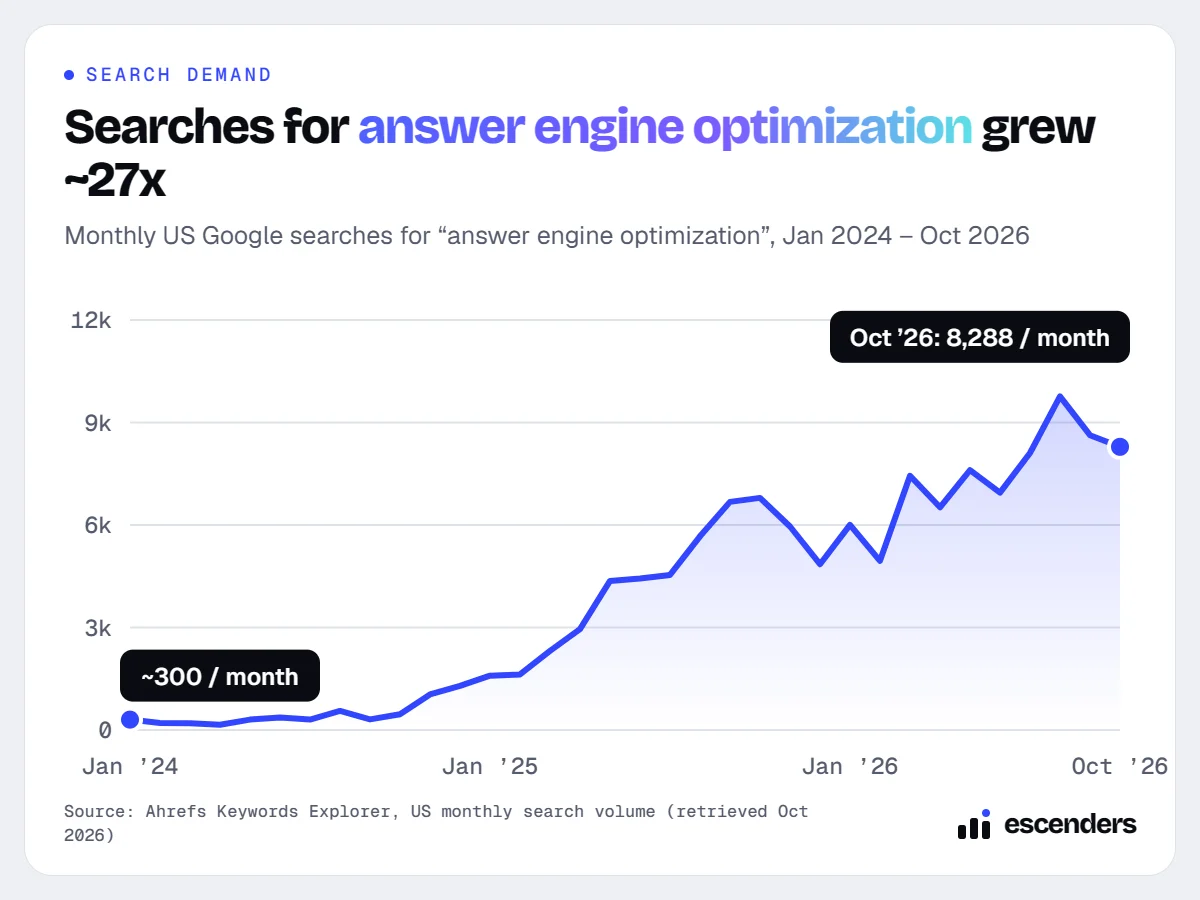
Interest is climbing fast. According to Ahrefs, US searches for “answer engine optimization” grew from about 300 a month in January 2024 to more than 8,000 a month by October 2026, as businesses noticed AI answers taking clicks from classic results.
What is an answer engine?
An answer engine is any search experience that replies with a direct, written answer instead of (or before) a list of links. Today the main ones are:
- Google AI Overviews and AI Mode — AI summaries at the top of Google results, with linked sources.
- ChatGPT search — ChatGPT browsing the web and citing pages in its replies.
- Perplexity — an answer engine built entirely around cited sources.
- Gemini and Microsoft Copilot — assistants that blend their own knowledge with live web results.
- Featured snippets and voice assistants — the older, pre-AI form of “answer” results, which still use many of the same signals.
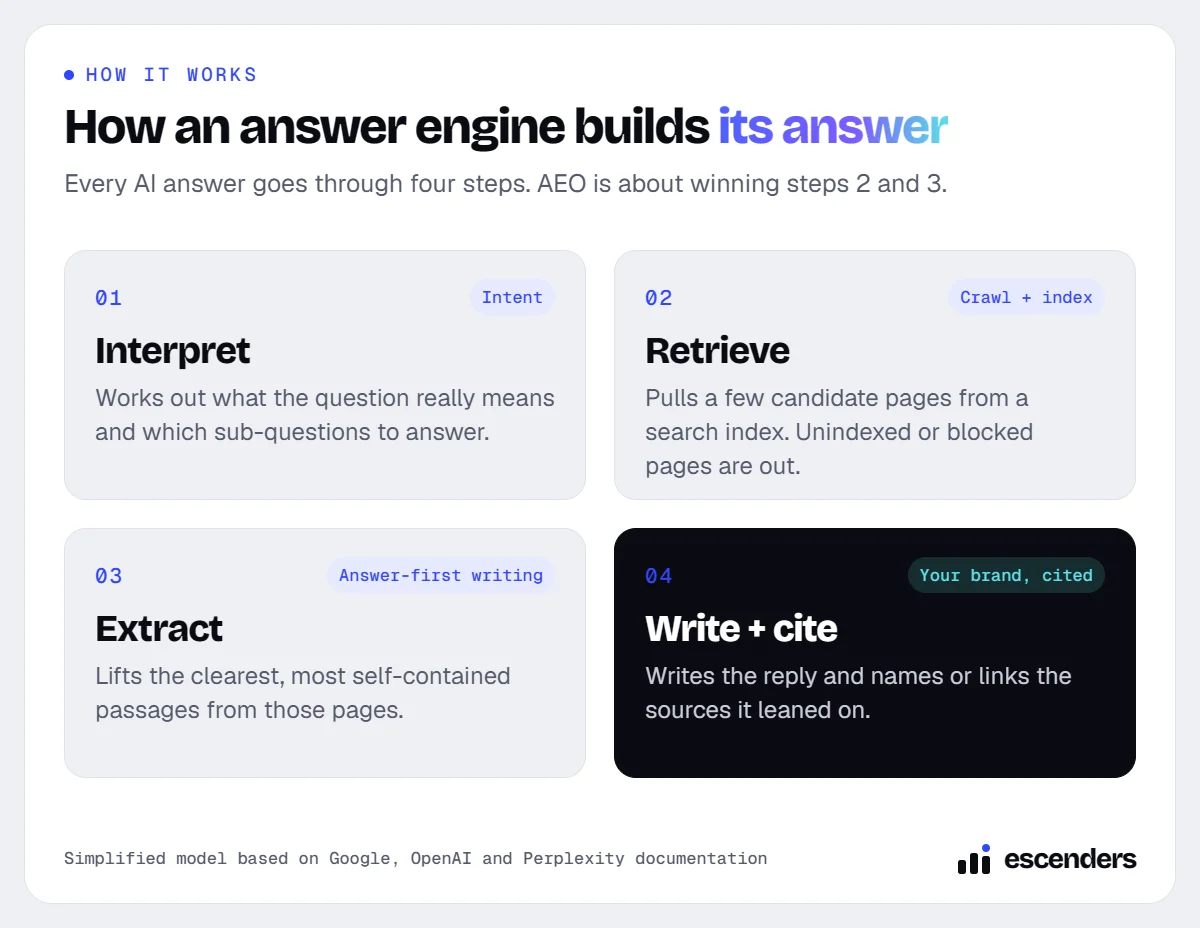
All of them do roughly the same thing: interpret the question, retrieve a handful of relevant pages, extract the passages that best answer it, and write a response — usually naming or linking the sources they leaned on. AEO is about winning that retrieval-and-extraction step.
How answer engines choose which sources to cite
No answer engine publishes its full ranking formula, but their behaviour and their own documentation point to the same few factors:
- They can crawl and index you. Google’s AI features use Google’s index. ChatGPT search uses OpenAI’s crawler (OAI-SearchBot) alongside third-party search indexes. Perplexity uses PerplexityBot. If you block these bots or your pages are not indexed, you cannot be cited.
- The passage directly answers the question. Engines quote passages, not whole pages. A clear, self-contained two-to-four-sentence answer near the top of a section is far easier to extract than an answer buried in a story.
- The source looks trustworthy. Named authors with real expertise, an identifiable business, consistent facts across the web and links or mentions from respected sites all raise the odds of being chosen — the same E-E-A-T signals Google has emphasised for years.
- The content is specific and current. Concrete numbers, prices, steps, dates and first-hand examples beat generic advice. Engines prefer pages that add something the other sources do not.
- Your brand shows up consistently elsewhere. AI models build their picture of a company from many sources: your site, directories, reviews, social profiles, forums and press. A brand that is described the same way everywhere is easier for a model to recognise and recommend.
AEO vs SEO vs GEO: what is the difference?
The three terms overlap heavily, and in practice you should do all of them together. Here is how they differ in focus:
| SEO | AEO | GEO | |
|---|---|---|---|
| Goal | Rank a page in the list of results | Be the source of the direct answer | Be mentioned and cited in AI-generated responses |
| Main surfaces | Google and Bing organic results | AI Overviews, featured snippets, voice, answer boxes | ChatGPT, Perplexity, Gemini, Copilot, AI Mode |
| Unit that wins | The page | The passage | The brand and its facts |
| Key levers | Relevance, links, technical health | Question-led structure, concise answers, schema | Brand mentions, entity consistency, original data |
| Success metric | Rankings, clicks | Snippet and AI Overview citations | Share of AI answers that mention you |
Think of SEO as the foundation, AEO as how you shape each page for extraction, and GEO (generative engine optimization) as how you make the whole brand recognisable to AI models. You can read more about how we combine them on our AI SEO, AEO and GEO services page.
The AEO checklist: 12 changes that make a page answer-ready
Access and indexing
- Allow the right crawlers. Check your robots.txt, firewall and CDN bot settings. Googlebot, Bingbot, OAI-SearchBot and PerplexityBot should be able to reach your public pages. (Blocking training crawlers such as GPTBot is a separate decision and does not stop search citation.)
- Confirm the page is indexed. Use Google Search Console’s URL Inspection tool and Bing Webmaster Tools. An unindexed page cannot appear in any AI answer.
- Serve the main content as HTML. Many AI crawlers do not run JavaScript well. If your key text only appears after scripts load, some engines will not see it.
Structure and wording
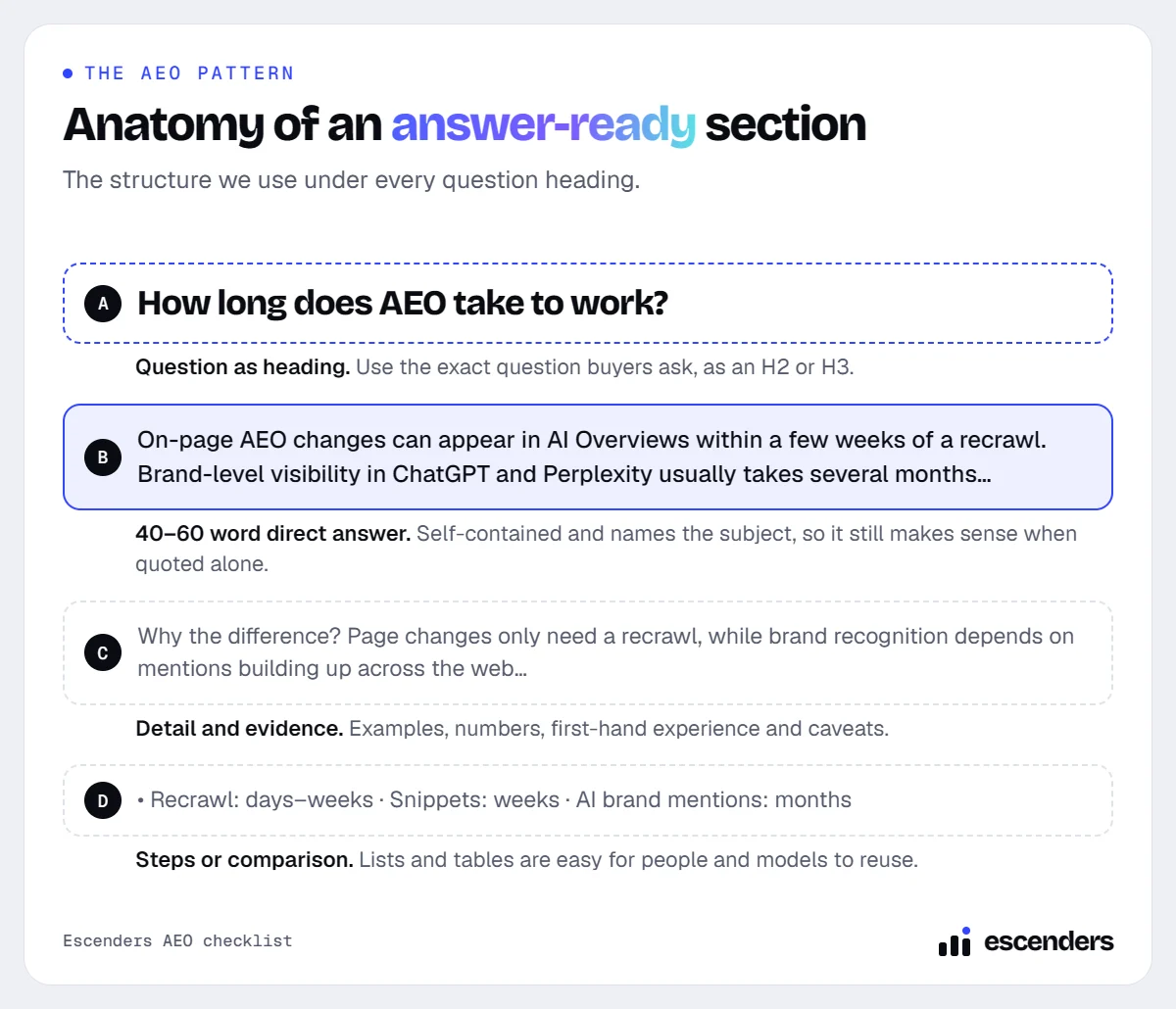
- Turn real questions into headings. Use the questions customers actually ask — from sales calls, support tickets, “People also ask” boxes and forums — as your H2s and H3s.
- Answer first, then explain. Put a direct 40–60 word answer immediately under each question heading, then expand with detail, examples and caveats. This is the passage engines lift.
- Make every answer self-contained. Avoid “as mentioned above” or “this”. Name the subject in the sentence so the passage still makes sense when quoted on its own.
- Use lists and tables for steps and comparisons. Structured formats are easy for both people and models to parse and reuse.
- Define terms plainly. If the page is about a concept, include a one-sentence definition that starts with “X is…”.
Trust and evidence
- Show who wrote it and why they know. Add a named author with a short bio and real credentials or experience, plus an About page that clearly explains who the business is.
- Add first-hand detail. Your own prices, timelines, screenshots, test results and client lessons are exactly the “information gain” that makes a source worth citing over a generic article.
- Add structured data. Organization, Person/author, Article, FAQPage, HowTo, Product and LocalBusiness schema help engines understand who you are and what each page contains.
- Keep it fresh. Update facts, prices and dates regularly and show a visible “last updated” date. AI answers favour current information, especially for anything that changes.
Beyond your own website: brand signals
On-page AEO gets your pages quoted. To get your business recommended — “what’s the best agency for X?” — answer engines also need to recognise your brand across the web. The highest-impact moves are:
- Consistent business profiles (Google Business Profile, LinkedIn, industry directories and review sites) with the same name, description and links.
- Genuine reviews on the platforms your buyers use.
- Mentions in industry publications, podcasts, roundups and “best of” lists.
- Helpful participation in communities such as Reddit and niche forums, which AI answers frequently cite.
- Original research or data that others reference and link to.
How to measure AEO results
AEO is harder to measure than classic rankings, but it is not a black box:
- Manual prompt checks. Keep a list of 20–50 questions your buyers ask. Run them monthly in ChatGPT, Perplexity, Gemini and Google, and record whether you are mentioned or cited.
- Referral traffic. In Google Analytics, watch sessions from chatgpt.com, perplexity.ai, gemini.google.com and copilot.microsoft.com.
- Search Console. AI Overview and AI Mode clicks are included in your Google Search performance data. Rising impressions on long, question-style queries are a good sign.
- AI visibility tools. Platforms such as Ahrefs Brand Radar, Semrush and others now track brand mentions inside AI answers at scale.
Common AEO mistakes
- Writing for keywords instead of questions. Answer engines match intent, not exact phrases.
- Burying the answer. Long introductions push the useful passage out of reach.
- Publishing generic AI-written content. If your page says the same thing as every other page, there is no reason to cite it.
- Anonymous content. Pages with no clear author or business behind them are weaker trust candidates.
- Blocking AI search crawlers by accident. Aggressive firewall or “block all bots” settings often stop the very crawlers that could cite you.
Frequently asked questions about answer engine optimization
Is AEO replacing SEO?
No. AEO builds on SEO. Answer engines still retrieve pages from search indexes, so crawlability, relevance and authority still matter. AEO adds a layer focused on structuring answers and building trust so those pages get quoted, not just ranked.
How long does AEO take to work?
On-page changes to pages that already rank can show up in AI Overviews and featured snippets within a few weeks of being recrawled. Brand-level visibility in ChatGPT and Perplexity usually takes several months, because it depends on mentions and reputation building up across the web.
Does schema markup help with AI answers?
Schema helps search engines understand what a page and a business are, which supports eligibility for rich results and makes your facts easier to interpret. It is not a guarantee of citation, but it is a low-cost, low-risk improvement that complements good content.
Can a small business compete in AI answers?
Yes — often more easily than in classic rankings. Answer engines reward the clearest, most specific answer to a question, not just the biggest domain. A small business with genuine expertise and well-structured pages can be cited alongside much larger brands.
Want to know if AI is recommending you?
We run the prompts your customers actually ask through ChatGPT, Perplexity, Gemini and Google AI Overviews, and show you who gets recommended instead of you — plus three quick wins you can act on straight away. Get your free AI visibility audit, or see our AEO and GEO services and content strategy sprint.