SEO Content Strategy: A 6-Step Framework That Works in 2026
On this page 7 sections
- What is an SEO content strategy?
- Why does an SEO content strategy matter in 2026?
- What are the steps of an SEO content strategy?
- What mistakes ruin an SEO content strategy?
- How long does an SEO content strategy take to work?
- Frequently asked questions about SEO content strategy
- Want a content plan built around your searches?
An SEO content strategy is a plan for which pages to publish, which searches each page should win, and how those pages connect and get measured. It links what your buyers search for to the pages on your site that answer it, so every article has a job instead of just filling a calendar.
Most business blogs fail for one reason: they publish what is easy to write instead of what people search for. A strategy fixes that order. You start from demand, check what Google already rewards, and only then decide what to write.
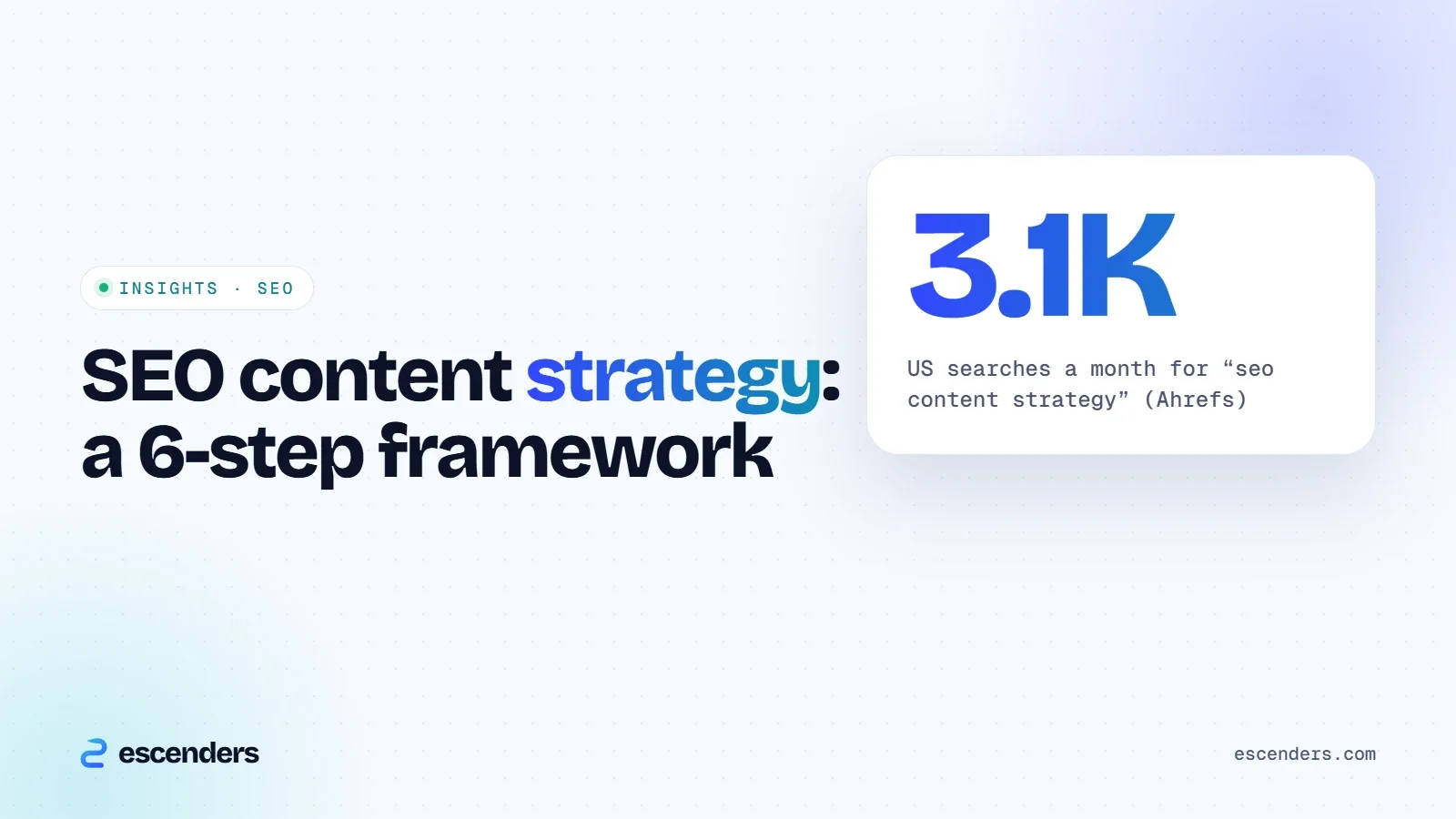
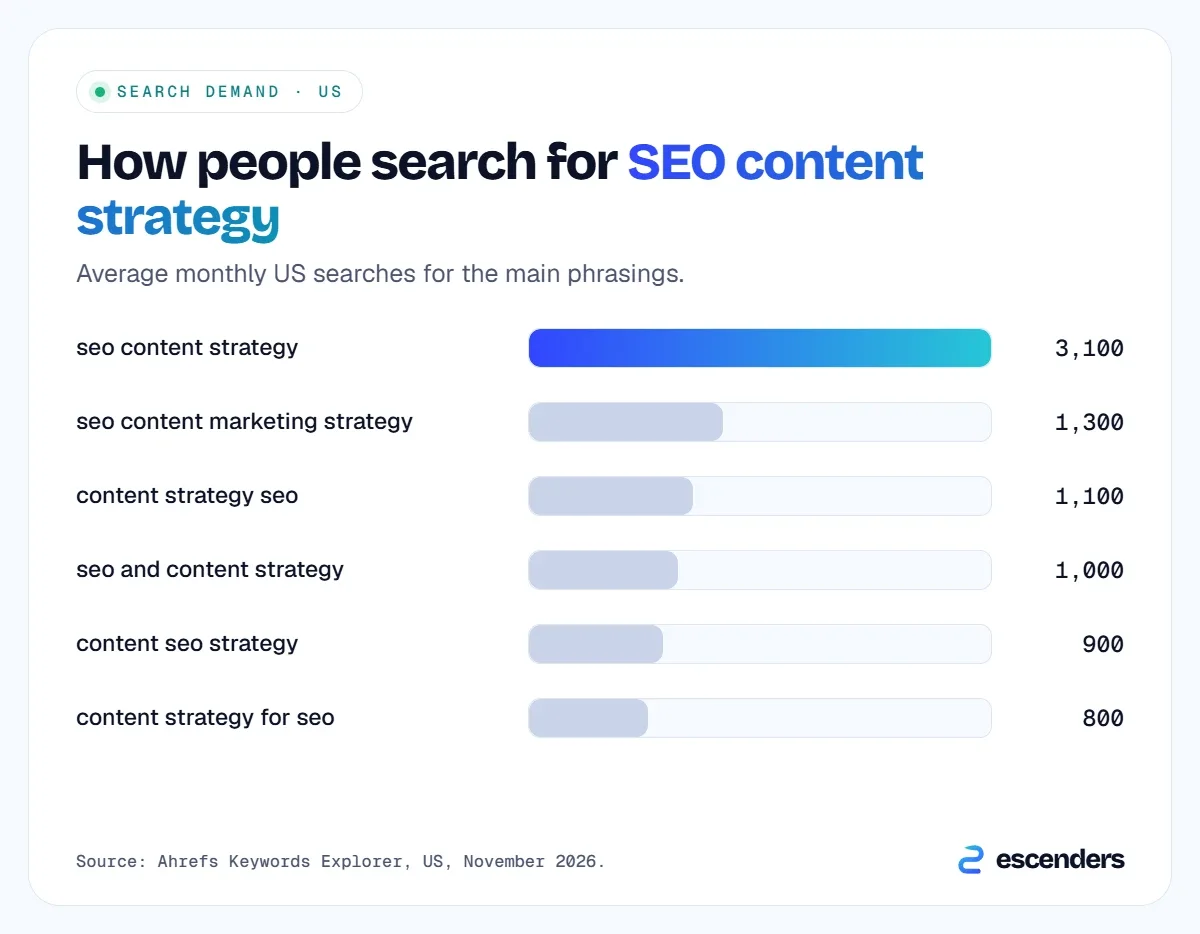
This guide gives the six-step framework we use at Escenders, with the real search data behind our own choices. People look for this in several ways. According to Ahrefs, “seo content strategy” gets about 3,100 US searches a month, and the close variants below add several thousand more.
What is an SEO content strategy?
An SEO content strategy is a documented plan that maps keywords and questions to specific pages, sets the order to publish them, and defines how each page is written, linked and measured. It turns keyword research into a roadmap. A keyword list on its own is not a strategy, and neither is a content calendar.
| Keyword list or calendar | SEO content strategy | |
|---|---|---|
| Answers | What do people search? When do we publish? | Which pages should exist, in what order, and why? |
| Search intent | Rarely checked | Checked against the live results |
| Site structure | Not included | Hubs, supporting pages, internal links |
| Measurement | Sometimes | One goal and one metric per page |
If you only want the writing side, our content production service covers it. The strategy is the part that decides what is worth writing in the first place.
Why does an SEO content strategy matter in 2026?
Search results are more crowded and more selective than they used to be. Google says its ranking systems are designed to prioritize helpful, reliable information created to benefit people, not content made to manipulate rankings. A strategy is how you make sure each page earns its place against that standard.
The results page for “seo content strategy” itself shows why. In Ahrefs, the page has an AI Overview and a People also ask box above the organic results, and the organic results are practical guides, a HubSpot Academy lesson, a Reddit thread and Google's own SEO starter guide. A thin post has little chance among those. A page that answers the question completely, with original examples, does.
AI answers raise the stakes. Pages that are cited by tools like ChatGPT and Google's AI features tend to be clear, self-contained and trustworthy, which is also what a good strategy produces. We cover that side in our guides to answer engine optimization and ranking in ChatGPT.
What are the steps of an SEO content strategy?
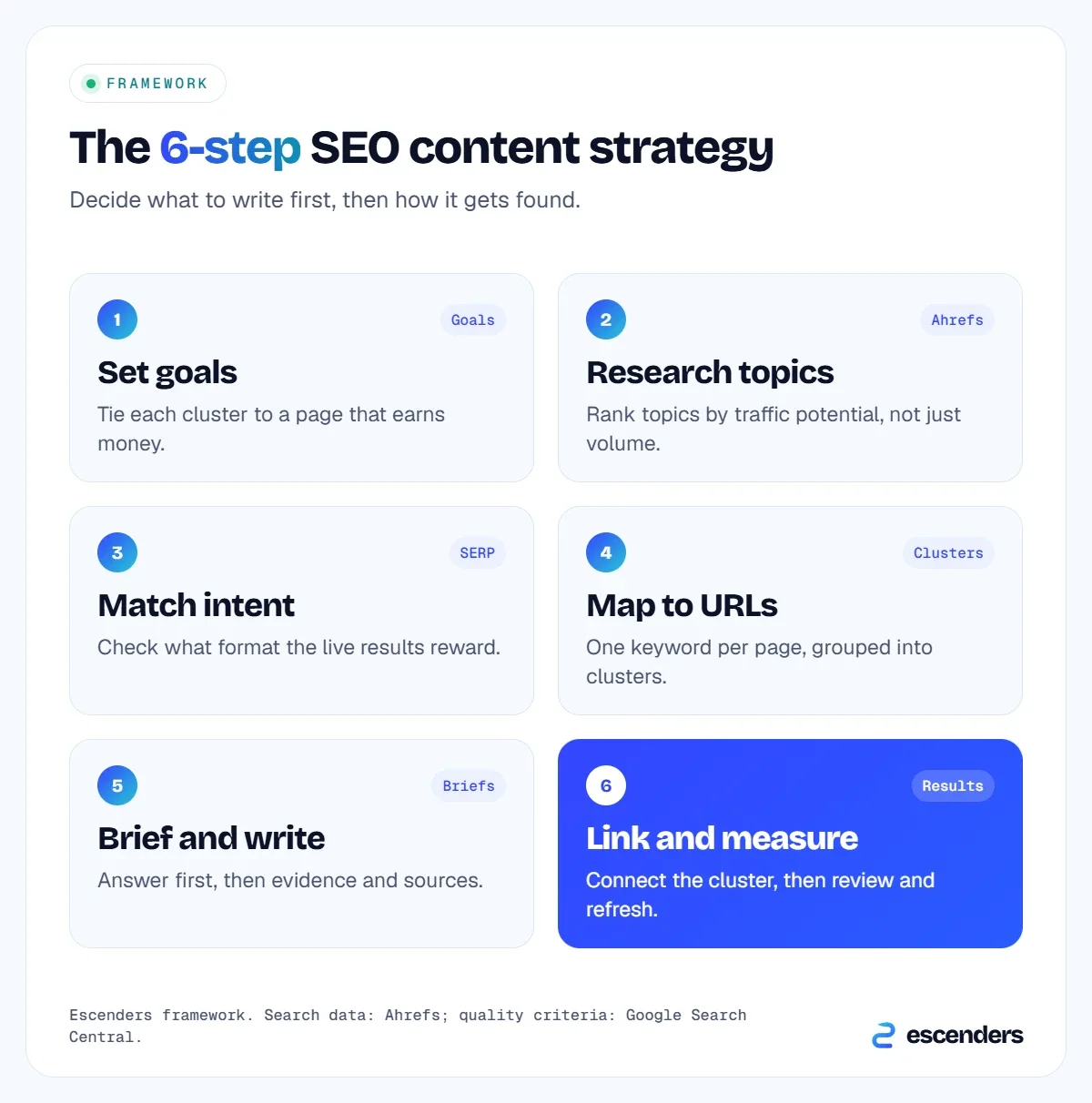
There are six: set goals tied to pages that earn money, research topics by traffic potential, match each topic to search intent, map topics to URLs in clusters, write answer-first pages from a brief, then link, publish and measure. Doing them in this order prevents most wasted articles.
1. Set goals tied to pages that earn money
Start with the pages that produce revenue: service pages, product pages, the audit or contact form. Write down which of them each content cluster should support. A blog post that cannot lead a reader toward one of those pages is entertainment, not strategy.
Pick one primary metric per cluster, such as organic visits to the money page, enquiries from organic search, or non-branded impressions. Keep the list short. Three clear goals beat ten vague ones.
2. Research topics by traffic potential, not just volume
Exact-match search volume understates what a topic is worth. Traffic potential, Ahrefs' estimate of the organic traffic the top page for a keyword receives from all the keywords it ranks for, is a better guide. Our own research shows why.
“Content strategy for seo” gets about 800 US searches a month at a keyword difficulty of 11. Yet Ahrefs puts its traffic potential at about 8,400 visits a month, because the top page ranks for the broader parent topic “seo content strategy” (3,100 searches). Choosing the topic, not the single phrase, is how you find the pages worth building.
For each topic, record volume, difficulty, traffic potential and the parent topic. Then collect the questions people ask. For this topic, Ahrefs lists 52 question keywords, led by “what is seo content strategy” at about 200 US searches a month. Those become your H2s and FAQ.
3. Match each topic to search intent
Before writing, open the live results and note what type of page ranks: guide, list, tool, product page or forum thread. Google rewards the format that satisfies the search, so a “best tools” query needs a list and a “what is” query needs a definition. If you write the wrong format, better writing will not rescue the page.
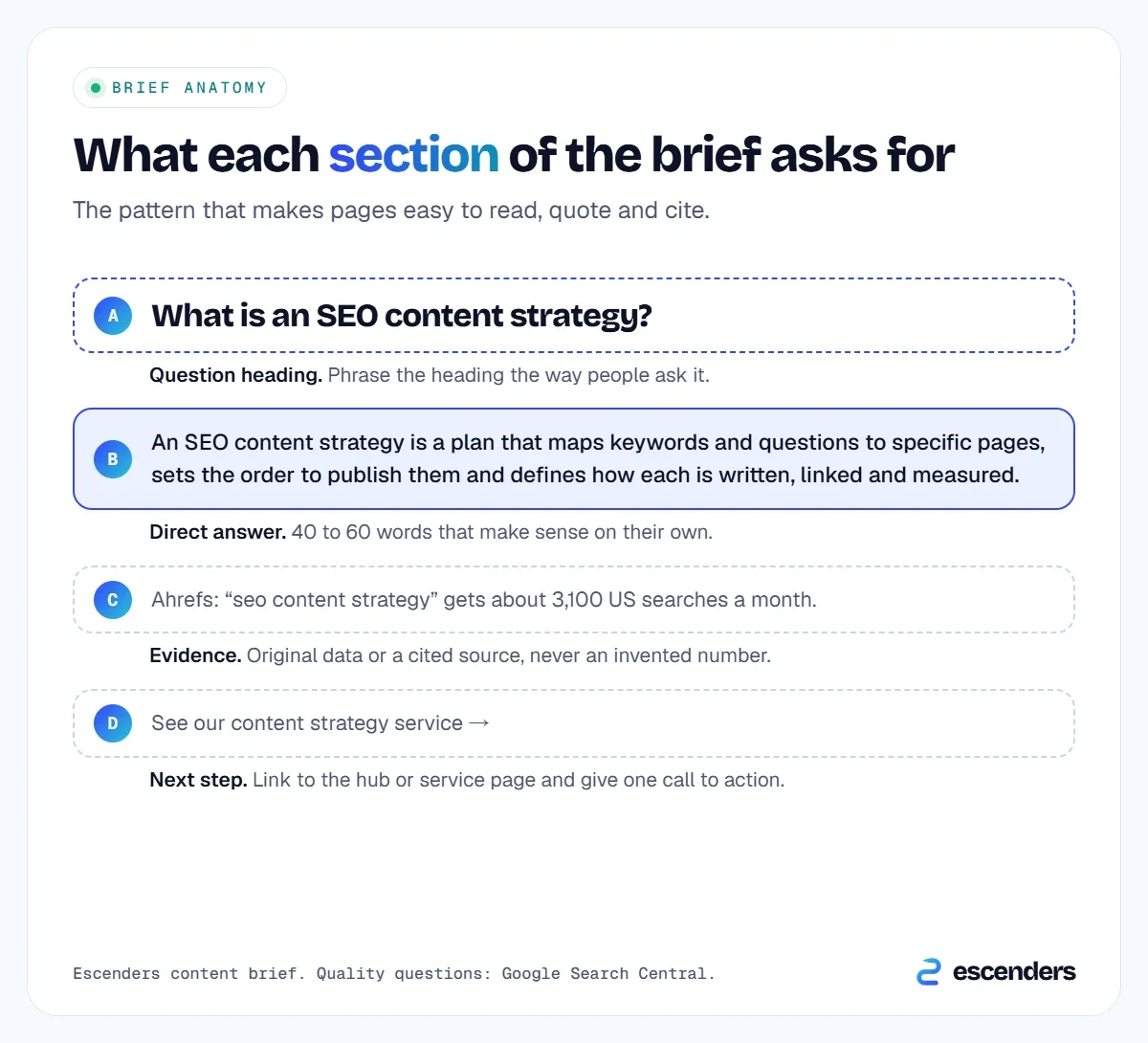
Note the SERP features too. An AI Overview or People also ask box tells you to put a direct, 40 to 60 word answer under a clear heading, then expand. Check which sites rank as well. If every result is a large brand with years of links, aim for a narrower question first.
4. Map topics to URLs in clusters
Group related topics into clusters: one broad hub page, plus supporting pages that each answer a narrower question and link back to it. Then assign each keyword to exactly one URL. Two pages chasing the same query compete with each other.
| Page role | Example and target | Links to |
|---|---|---|
| Hub | SEO content strategy guide (the broad parent topic) | Every supporting page and the service page |
| Supporting page | Content brief template (one narrower question) | The hub and the service page |
| Money page | SEO services (buyer-intent searches) | Contact or audit form |
This map is the heart of the strategy. It is also where a specialist helps most, because the wrong map wastes months. Our content strategy service starts here.
5. Write answer-first pages from a brief
A one-page brief keeps writers on track and makes every article consistent. It names the primary keyword, the reader, the intent, the questions to answer, the sources to cite, the internal links and the call to action. Without one, drafts drift.
Google's own self-assessment questions are a useful quality bar. They ask whether the content provides original information, reporting, research or analysis, whether it offers a substantial, complete description of the topic, and whether it adds real value compared with other pages in the results. If a draft would not pass, it is not ready.
6. Link, publish and measure
Link each new page to its hub and to the money page, and link back from older posts so the cluster is connected. Submit the sitemap and, if your platform supports it, use IndexNow so Bing and others find the page quickly.
Then review each page on a fixed rhythm. Check impressions, clicks and the queries it appears for in Search Console, and compare against the single metric you set in step one. Update pages that rank on page two with better answers or new evidence, rather than writing something new.
What mistakes ruin an SEO content strategy?
The common mistakes are publishing without checking intent, targeting the same query on several pages, chasing high-volume terms you cannot win, and never updating. Each one wastes effort that a short planning step would have saved.
- Writing for keywords, not questions. Pages built around a phrase read thinly. Pages built around the questions behind it get cited and shared.
- Skipping the SERP check. If the results are all tools and you publish an essay, the page will not rank.
- Ignoring difficulty. Start where the top results are beatable, then move up the difficulty ladder as your site earns links and trust.
- Publishing and forgetting. A strategy includes updates. Dated facts quietly lose rankings.
- No path to revenue. Traffic that never meets a service page or an enquiry form is hard to justify.
How long does an SEO content strategy take to work?
New pages usually need weeks to be crawled and months to settle in the results, and nobody can promise a position. How quickly you see traffic depends on your site's authority, the difficulty of the topic and how closely each page matches intent. Plan on a quarter before judging a cluster.
You can speed up the first signals by starting with low-difficulty questions, linking new pages from strong existing ones and refreshing pages that already have impressions. If your site is new, expect the first wins in the narrow, specific searches.
Frequently asked questions about SEO content strategy
What is the difference between content strategy and content marketing strategy?
A content marketing strategy covers all content and channels, including email, social and video. An SEO content strategy is the part focused on earning organic search traffic: which searches to target, which pages to build and how to structure and link them. Most small businesses should start with the SEO part.
How many keywords should one page target?
One primary keyword or topic per page, plus the closely related phrases and questions that the same page can answer naturally. Because Google groups similar queries, a well-built page often ranks for hundreds of variations. Avoid splitting one topic across several thin pages.
How often should I update my content?
Review each important page at least twice a year, and sooner when the facts change or the page starts losing impressions. Update statistics, examples, screenshots and links, and add new questions from Search Console. Keep the URL the same so the page keeps its history.
Do I need a different strategy for AI search?
No, but you need to write for it. The foundations are the same: clear answers, original evidence and trustworthy sources. Add direct answers under each heading, consistent business facts and mentions on other reputable sites. Our guide to generative engine optimization explains the extra steps.
Can I do this myself or do I need an agency?
You can do it yourself if you have time to research and the discipline to follow the order of the steps. An agency helps most with the cluster map and the ongoing production, where mistakes are costly. Either way, you should own the plan and be able to read it.
Want a content plan built around your searches?
We review your site, find the topics your buyers search for and send a short plan of the pages that would help most. Get my free website & SEO audit, or see our content strategy service if you want us to build and run it.
Sources: Ahrefs Keywords Explorer, US data (retrieved November 2026); Google Search Central, “Creating helpful, reliable, people-first content”.

Shoaib Anjum founded Escenders in 2021. He has written and planned content since 2017 for 50+ clients, and now leads the studio's SEO, content strategy and website work.