
Generative engine optimization (GEO) is the practice of shaping your content, website and wider brand presence so that AI answer engines (ChatGPT, Perplexity, Gemini and Google’s AI Overviews and AI Mode) can find it, trust it, and cite or recommend it when they write an answer.
Classic SEO asks “where do we rank?” GEO asks a different question: “when someone asks an AI tool about our category, are we in the answer, and is our page the source it links to?” This guide explains where the term comes from, how generative engines pick their sources, what the research actually measured, what Google says on the record, and the six-step workflow we use at Escenders when we want a page to be cited.
What is generative engine optimization (GEO)?
Generative engine optimization is the work of increasing how often, and how prominently, your content appears inside AI-generated answers. Instead of competing for one of ten blue links, you compete to be one of the few sources an AI engine reads, quotes and links when it writes its response. Good SEO is the foundation; GEO adds clarity, evidence and off-site reputation on top.
The term was coined in a research paper, “GEO: Generative Engine Optimization”, by researchers from Princeton University and IIT Delhi, published at the ACM KDD conference in August 2024. The authors describe GEO as a new paradigm where creators aim to increase their visibility “in generative engine responses.” Since then the label has spread through the marketing industry, alongside close cousins such as answer engine optimization (AEO), LLM SEO and AI search optimization.
The key shift is the unit of success. In a classic results page you win a position. In an AI answer you win a mention (your brand is named), a citation (your page is linked as a source), or both. A page can rank fifth on Google and still be the source an AI Overview quotes, and a brand can be recommended by ChatGPT without anyone clicking a search result at all.
Why GEO matters now: the demand data
Interest in the topic went from almost nothing to a mainstream marketing term in about eighteen months. According to Ahrefs Keywords Explorer, US searches for “generative engine optimization” were 113 in January 2024, peaked at 17,048 in July 2025, and have held at roughly 7,000 to 9,300 a month through most of 2026. Ahrefs puts the current 12-month average at 7,800 US searches and 27,000 worldwide.
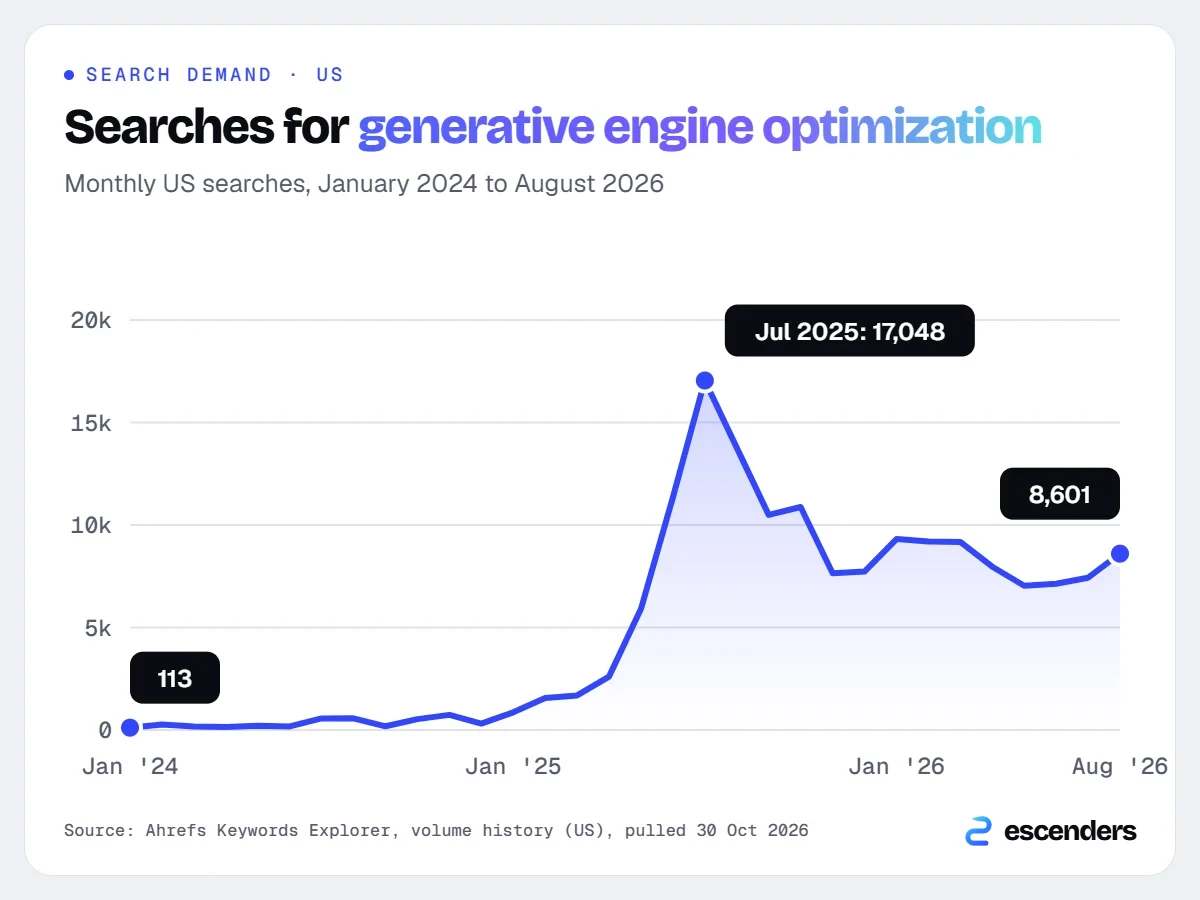
The surrounding searches tell the same story. Ahrefs shows 4,900 monthly US searches for “ai search optimization”, 3,900 for “what is generative engine optimization” and 2,600 for “geo vs seo”. Marketers, founders and in-house teams are clearly trying to work out what changes when buyers ask an AI tool instead of typing a query into Google.
How do generative engines choose which sources to cite?
Most AI answer engines work in two stages. First they retrieve: a search index (Google’s own, Bing, or the engine’s own crawler) returns candidate pages for the question. Then they generate: a language model reads passages from those pages and writes an answer, citing the sources it leaned on. To be cited, you must be retrievable first and quotable second.
Retrieval is mostly classic SEO. Google says its generative AI features are rooted in its core Search ranking and quality systems, and that a page must be indexed and eligible to appear with a snippet before it can show up in AI Overviews or AI Mode (Google Search Central). ChatGPT search and Perplexity run their own crawlers, so blocking those crawlers can quietly remove you from their answers.
Generation is where GEO-specific work pays off. When the model has five or ten candidate passages, it favors the ones that answer the question directly, state facts precisely, and back them with evidence. Brand recommendations (“which agency should I hire?”) also draw on what the wider web says about you: reviews, directory listings, articles and discussions that mention your name.
Which crawlers do AI search engines use?
Google uses its normal Googlebot for AI Overviews and AI Mode. OpenAI uses OAI-SearchBot to surface sites in ChatGPT search, and Perplexity uses PerplexityBot to surface and link sites in its results. Training crawlers such as GPTBot are separate, so you can opt out of model training without disappearing from AI search.
| Crawler | Operator | What it does | Our advice |
|---|---|---|---|
| Googlebot | Crawls for Google Search, which also feeds AI Overviews and AI Mode | Always allow | |
| OAI-SearchBot | OpenAI | Surfaces websites in ChatGPT search answers; opted-out sites are not shown there | Allow if you want ChatGPT citations |
| GPTBot | OpenAI | Collects content that may be used to train OpenAI models | Your choice; separate from search |
| ChatGPT-User | OpenAI | Visits a page when a ChatGPT user asks about it; not an automatic crawler | Leave allowed |
| PerplexityBot | Perplexity | Surfaces and links websites in Perplexity results; not used for model training | Allow |
| Perplexity-User | Perplexity | Fetches pages to answer a user question; generally ignores robots.txt | No action needed |
Sources: OpenAI crawler documentation and Perplexity crawler documentation. Both companies say robots.txt changes can take up to about 24 hours to take effect.
GEO vs SEO vs AEO: what is the difference?
SEO earns rankings and clicks in search results. AEO earns the direct answer: featured snippets, voice answers and AI summaries. GEO earns mentions and citations inside AI-generated responses across ChatGPT, Perplexity, Gemini and Google’s AI features. They overlap heavily: in practice GEO and AEO are layers on top of solid SEO, not replacements for it.
| SEO | AEO | GEO | |
|---|---|---|---|
| Main goal | Rank pages and earn clicks | Be the direct answer to a question | Be mentioned and cited in AI answers |
| Where it shows | Google and Bing organic results | Featured snippets, People Also Ask, voice, AI Overviews | ChatGPT, Perplexity, Gemini, Copilot, AI Overviews and AI Mode |
| Success metric | Positions, organic traffic, conversions | Snippet and answer ownership | Share of mentions and citations across a prompt set |
| Main levers | Technical health, relevance, links | Question headings, concise answers, structure | Evidence, clarity, crawler access, brand mentions off-site |
| Time horizon | Months | Weeks to months | Weeks for retrieval-based answers; longer for what models know about a brand |
Google itself does not draw a hard line. Its guidance says that optimizing for generative AI search “is optimizing for the search experience, and thus still SEO.” We agree, and we treat GEO as a set of extra checks on pages we already want to rank. If you want the answer-focused side in depth, read our guide to answer engine optimization.
What does the research say actually works?
The original GEO study tested nine content changes on a benchmark of 10,000 queries. Adding quotations from relevant sources, adding statistics, citing sources and improving fluency gave the biggest gains in how much of a page made it into AI answers. Keyword stuffing, the old SEO habit, performed worse than doing nothing.
The researchers built GEO-bench, a set of 10,000 queries across many domains, then rewrote source pages using each method and measured how much of each page’s content appeared in the generated answer, weighted by where it appeared. The paper’s abstract reports that GEO “can boost visibility by up to 40%” in generative engine responses, and a follow-up test on Perplexity.ai showed improvements of up to 37%.
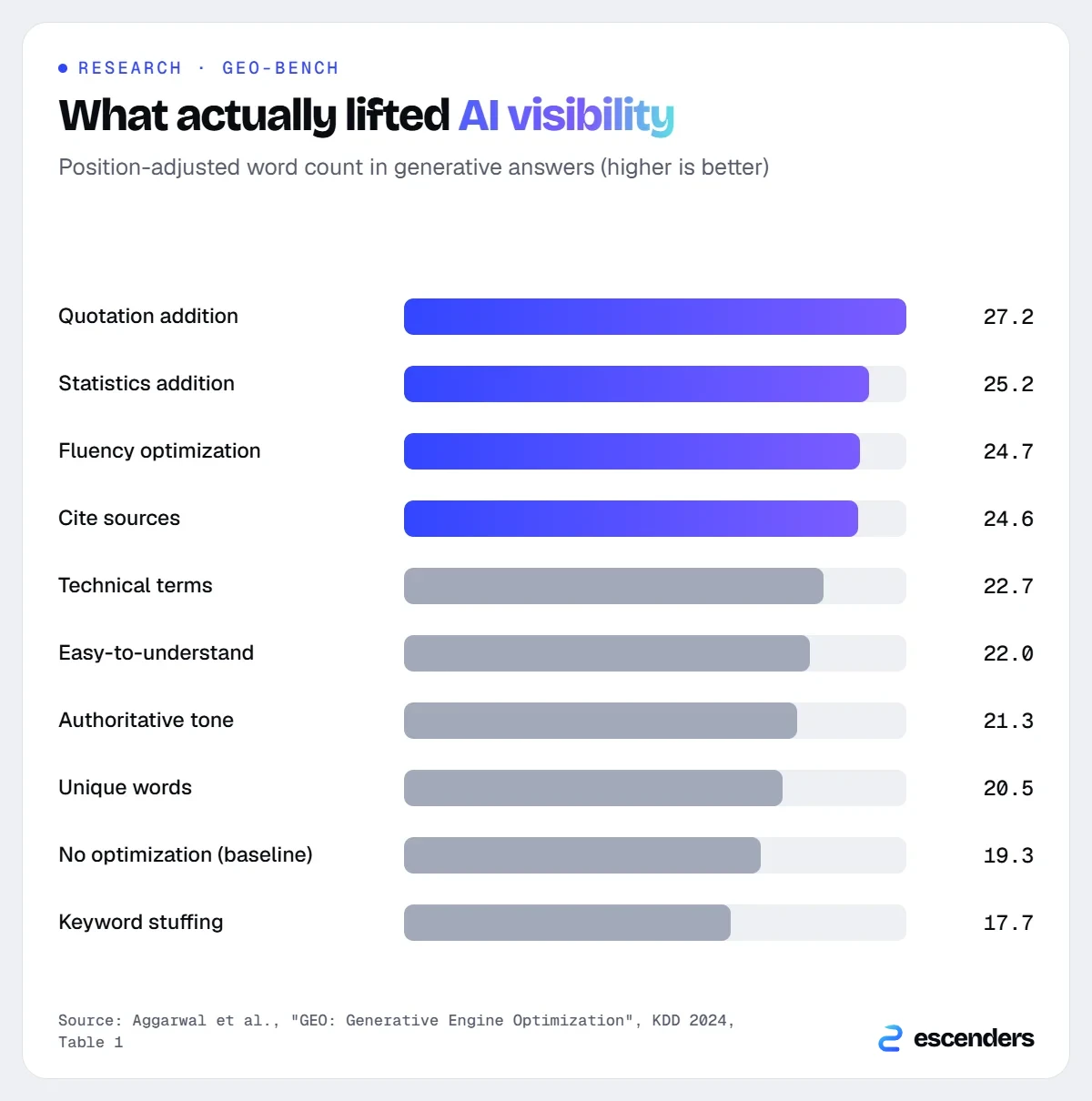
On the paper’s position-adjusted word count metric, the unoptimized baseline scored 19.3. Quotation addition scored 27.2 (about 41% higher, by our arithmetic), statistics addition 25.2, fluency optimization 24.7 and cite sources 24.6. Keyword stuffing scored 17.7, below the baseline.
Two cautions before you rewrite everything. First, this was a controlled study on a research setup built in 2023, not a live audit of today’s ChatGPT or Gemini. Second, the paper measures how much of a page gets used once it is a candidate source; it does not replace the need to be retrieved in the first place. We read it as strong directional evidence: answers backed by real numbers, named sources and clear prose get used more.
What does Google say about optimizing for AI features?
Google’s official position is that normal SEO best practices still apply to AI Overviews and AI Mode, because these features are built on its core ranking and quality systems. It says you don’t need special AI files, markup or Markdown, and that pages made mainly to manipulate AI answers break its spam policies.
The points from Google’s guide to optimizing for generative AI features that matter most for GEO work:
- Bring a unique point of view. Google asks for original insight, not a summary of existing content.
- Be eligible. Pages must be crawlable, indexed and eligible to show with a snippet.
- Skip the gimmicks. Google Search ignores llms.txt files, and there is no special schema markup for AI features. There is also no requirement to break content into tiny chunks.
- Don’t build pages to game AI answers. Google says this violates its scaled content abuse policy.
- Write for people. The closing principle is to focus on what visitors would find helpful and satisfying.
Other engines publish less, but their crawler documentation points the same way: be accessible, be clear, be worth citing.
How to do generative engine optimization: our 6-step workflow
Start by making sure AI crawlers can reach and index your pages. Then map the questions buyers ask AI tools, answer each one directly, back your answers with evidence, build mentions of your brand on trusted sites, and track which sources each engine cites every month. This is the process we run for clients and for our own site.
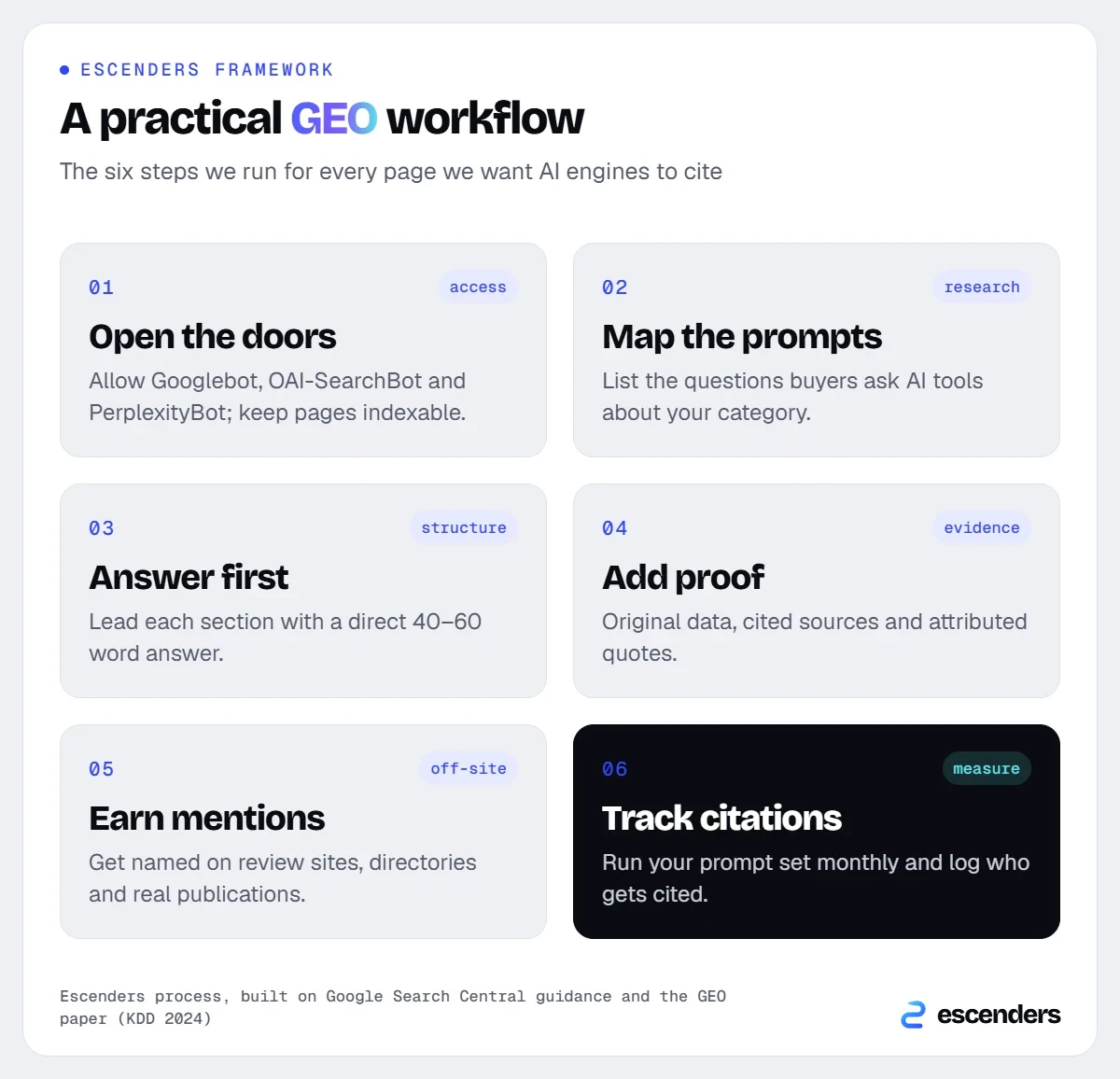
1. Open the doors to AI crawlers
Check robots.txt for Googlebot, OAI-SearchBot and PerplexityBot, then check your CDN or firewall: some security settings block AI crawlers without anyone on the marketing team knowing. Make sure key content is in the HTML (not only rendered by JavaScript), pages are indexed in Google Search Console and Bing Webmaster Tools, and your sitemap is clean.
2. Map the prompts your buyers use
List 20 to 50 questions people ask an AI tool before they would buy from you: “what is…”, “how do I…”, “best X for Y”, “X vs Y” and “who offers X in [country]”. Keyword tools help here. For this very topic, Ahrefs shows question searches like “how does generative engine optimization work” (500 a month in the US) and “how to measure generative engine optimization” (100). Sales calls, support tickets and Reddit threads fill in the rest.
3. Answer first, then explain
Open each page with a one-to-two-sentence definition or answer. Use question-style headings and give a direct 40 to 60 word answer under each, then the detail. Use tables for comparisons and lists for steps. This is not about chopping content up for machines (Google says that’s unnecessary); it simply makes your best sentence easy to find and quote, for readers and models alike.
4. Add proof the model can quote
This is where the research is clearest. Add statistics with a link to the primary source, quotes attributed to named, real experts, and original data only you have: survey results, benchmarks, pricing tables, before-and-after numbers. Show an author with real credentials and a visible “last updated” date. Never invent numbers: an AI engine that repeats a made-up statistic tied to your brand is a reputational risk, not a win.
5. Earn mentions beyond your own site
When someone asks “which company should I use?”, models lean on what others say about you. Keep your company details consistent across your site, Organization schema, LinkedIn, Crunchbase and review platforms. Collect genuine reviews, get listed in relevant directories, contribute expert commentary to real publications, and take part in community discussions honestly. Google notes that inauthentic mentions are not useful, so skip paid link schemes.
6. Track citations every month
Run your prompt set in ChatGPT, Perplexity, Gemini and Google AI Mode once a month. For each prompt, log whether your brand is mentioned, whether your page is cited, and which competitors appear. Pair that with analytics: referral visits from chatgpt.com, perplexity.ai and gemini.google.com, plus Search Console clicks to the pages you optimized. Over a few months you get a share-of-answer trend you can actually act on.
Common GEO mistakes to avoid
- Blocking the crawlers you need. Blocking GPTBot for training is a fair choice; blocking OAI-SearchBot or PerplexityBot removes you from their answers.
- Keyword stuffing. In the GEO study it scored below the unoptimized baseline.
- Mass-producing AI rewrites. Thin, scaled pages built to catch AI answers run into Google’s spam policies and rarely earn citations.
- Treating llms.txt as a silver bullet. Google Search ignores it. It is harmless, but it won’t fix weak content.
- Measuring only rankings. A page can lose clicks while gaining citations. Track both.
How long does generative engine optimization take?
For engines that search the web live (Google AI Overviews and AI Mode, ChatGPT search, Perplexity), improvements can show up as soon as a page is recrawled, re-indexed and ranks for the underlying query, often within weeks. Changing what a model “knows” about your brand from its training data takes longer and depends on its next update.
That is why we run both tracks at once: page-level work for retrieval, and reputation work for the longer game. Neither works without the basics of a fast, crawlable site with genuinely useful content.
Looking for hands-on help? See our generative engine optimization agency service.
Frequently asked questions
Is GEO replacing SEO?
No. Google says SEO best practices still apply to its AI features because they are built on its core ranking systems, and ChatGPT and Perplexity also rely on search indexes to find sources. GEO adds extra work on top: clearer answers, stronger evidence and off-site mentions. Teams that drop SEO to “do GEO” usually lose both.
What is the best tool for generative engine optimization?
There is no single best tool. You need a keyword tool for prompt research (such as Ahrefs or Semrush), Google Search Console and Bing Webmaster Tools for indexing, and a way to track AI answers, either a dedicated AI visibility tracker or a monthly manual prompt log. Google notes that no third-party tool can see inside its ranking or AI systems.
Does llms.txt help with GEO?
Not for Google: its guidance says Google Search ignores llms.txt files and that no special AI files are needed. Some other tools may read it, so adding one is harmless, but it does nothing for pages that aren’t crawlable, clear and worth citing.
Can a small website get cited by AI engines?
Yes. AI answers cite pages, not just big brands, and they favor the passage that answers the question best. A small site with a precise answer, original data and clear sourcing can be cited next to much larger competitors, especially on specific, long-tail questions.
How do you measure GEO results?
Track a fixed set of prompts monthly across the main AI engines and record mentions, citations and competitors. Add referral traffic from AI tools in your analytics and Search Console clicks to optimized pages. Look at trends over three to six months rather than single answers, which change from run to run.
Want to know how AI engines see your brand?
We build and grow websites with SEO and content at the core, and AI search visibility is part of every SEO plan we run. Get a free website and SEO audit and we’ll show you where you stand in Google and AI answers, or see how our SEO services and content strategy work.